This review contains slight spoilers for Chiikawa the Movie: The Secret of The Mermaid Island.
As the credits to Chiikawa the Movie: The Secret of the Mermaid Island rolled and the lights in the theatre came on, I thought of a couple of things.
I remember the ending song, Tsukue Sasaru, sung by the titular character Chiikawa’s voice actress Haruka Aoki herself. I remember thinking that the gentle and heartwarming song, along with the ending credit illustrations depicting the characters’ daily lives after they came back from said Mermaid Island, was perfect to close out the movie with.
I remember seeing text on screen telling the audience to stay and not miss the after credits scene and thinking, “okay”. After the hour and a half or so I’d experienced, I would gladly be seated for an hour more, let alone for just a couple of minutes.
I remember looking left and right to see very confused faces, trying to process what they just saw. It felt like not a single adult in the theatre walked out of there smiling contentedly.
And then the after credits scene played and I could hear several people in the audience audibly gasp.
Not Your Typical Cute Mascots
Chiikawa (short for Nanka Chiisakute Kawaii Yatsu, lit. ’something kind of small and cute’) is an unusual work. Originally created by nagano as a series of webcomics posted to Twitter/X, the still-ongoing series exploded in popularity around 2020, and received a still-ongoing short anime adaptation in 2022. The series has been known for its adorable mascot characters that spawned a veritable merchandising empire popular with all ages, Chiikawa goods are now almost as ubiquitous as Sanrio character merchandise in some countries.
But it’s also known for, and has garnered quite the amount of fans from, its surprising hidden depth. The world & setting in which friends Chiikawa, Hachiware (Makoto Tanaka), & Usagi (Ari Ozawa) live in gets very dark very fast when scrutinized small creatures like Chiikawa have to work jobs to earn their keep, and a lot of times work means “subjugation” gigs, where they need to take down monsters twice their size at the risk of being eaten, or worse. You read that right. Those critters are living through the horrors of a gig economy.
Yet to say that Chiikawa is only “dark” feels like doing it a disservice. Yes, it does contain some serious elements & themes, but so do Aesop’s Fables and Grimm’s Fairy Tales. Yes, there’s a constant awareness that something complex and scary is always out there just off-screen. But Chiikawa is still, and arguably is, a fun series about incredibly adorable small critters who sing and dance and do their best to go about their day and cherish the little things in life. It would not have gained recognition, nor have found an adoring audience of fans who watch the anime each week to be healed, had it not been able to deliver on the cuteness & heartwarming character antics week after week. So Chiikawa is many things: sometimes light-hearted, sometimes funny, sometimes scary. And at the end of the day, it leaves an impression on you and makes you think.
In a way, it reminds me of works like Astro Boy, Doraemon, or even Nekojiru in some regards. I could even make a more extreme comparison to Dark Souls, not just in how harsh & unforgiving the work’s setting seems, but in how much of its narrative is defined by “negative spaces” and things implied, not stated. So it’s no wonder that the work has many older fans, when the world of Chiikawa is full of such things to scrutinise that lead to rabbit holes & unnerving conclusions when actually examined.
All of that already exists as convention, and is set up in the preceding stories of the webcomic and anime. So when Chiikawa geared up for its first long-form story arc, of which the Secret of the Mermaid Island movie is adapted from, those in the know were prepared for anything that might come.
Or so they would think.
Not Your Usual Heartwarming Adventure
Chiikawa the Movie, and the “Siren Arc” it’s adapting, marks a departure from earlier stories in that it spotlights those uneasy implications and horrors previously just off to the side. Not exactly front and centre, but just enough that it’s hard not to notice. And even as someone who considers themselves an enfranchised fan of the work and its characters, I couldn’t help but walk out of the theatre thinking, what exactly did I just watch?
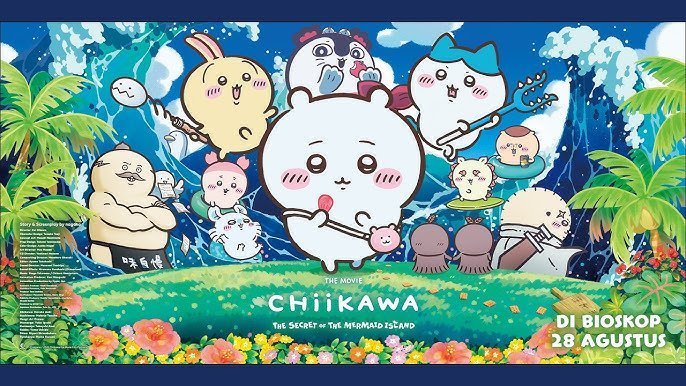
Like Chiikawa, the film, too, is many things. What starts as a fun summer adventure movie soon turns into a murder mystery. One day, Chiikawa and friends receive an invitation to a mysterious island with the promise of a feast and rewards aplenty. Yet they soon realise that the invitation turns out to be a distress call from the islanders, who ask the cast to take down Siren (Suzuki Minori), a giant creature who’s been kidnapping islanders with chilling implications. But to complicate things, it’s also revealed that Siren herself is acting on revenge: someone from the island took and ate one of her mermaid companions, and she won’t stop until she finds out who.
If that also sounds like a kaiju movie where characters try to deal with the monstrous fallout of past sins humans have made against nature & the kaiju, that’s because it kind of is. There’s a constant theme running throughout the movie of who the blame lies with, as Chiikawa and co. are trapped in the conflict between Siren and the islanders. Who’s in the wrong here? What’s the truth behind the conflict, and is it even right to uncover it? Do the wronged deserve vengeance and is that vengeance justified? What can be done to make things right, if things can even be made right anymore in the first place?
Chiikawa the Movie effortlessly dances between those questions, sometimes even accompanied by song. From silly scenes displaying each character’s signature quirks, to tense chase sequences, to colourful rap battles, to quiet revelations that leave you feeling like your stomach dropped, none of it feels out of place in the film.
Despite everything I’ve said, I would be lying if I said I didn’t laugh, smile, and have a lot of fun watching the movie. On top of that, the “Siren Arc” features the first time all of the work’s main cast are gathered together in the same story, so it’s a joy to see them all on the big screen Avengers-style. Though the conclusion of the story and the particularly shocking post-credits scene still leave me with a jumble of emotions inside that’s a lot to process.
But maybe I have it all wrong by focusing too much on the dark and heavy parts.
It’s the Little Things in Life
I think back again to the ending song playing during the credits, lyrics talking about the small, precious moments, “putting them to writing and taking pictures because I’m scared I’ll forget”.
I think back to watching the movie with friends new to Chiikawa, looking left and right to see their very confused faces, laughing together trying to make sense of what we just saw. Sure, the initial shock of the post-credits scene was shocking, but the joy of processing what we watched together felt like it doubled the enjoyment we got out of the film.
In a way, it was like we just experienced our own summer adventure similar to Chiikawa and the gang. And like Chiikawa, by laughing along with friends despite the feeling of uneasiness, we would be able to return to our own daily lives unbothered- maybe even slightly more refreshed.
The more that I think about it, it’s here that Chiikawa‘s core strength as a work is revealed. Despite the horrors, despite the challenges, Chiikawa and their friends persist. Not just by surviving, but by celebrating & cherishing the small joys in daily life, whether it’s studying together for exams or sharing a sukiyaki set you got from a giveaway with friends. It’s demonstrated in the film’s emotional climax as the culprit and their motives are revealed- although only to Chiikawa and the audience. In a surprising moment that reminds me of Wake Up Dead Man, Chiikawa chooses quiet grace and valuing friendship instead of exposing the culprit or retributive justice. It’s with this decision, and by returning the mermaid scale to the sea, almost as if exorcising ghosts and offering a prayer to the deceased, that Chiikawa symbolically breaks the chain of hatred and can return to their peaceful daily life, absolved of wrongdoing and guilt.
And yet the same can’t be said of the culprit, implied to meet a rather grisly fate despite a last effort to save themself and spare the islanders. Both outcomes exist despite both having noble intentions, so in the end, what exactly is Chiikawa the Movie trying to say?
But maybe that’s the point: Chiikawa the Movie, like life, is many things, and asks you to consider which parts of it are the important ones and whether they exist defined by its opposite, or exist despite it. Is Chiikawa a horror series occasionally broken by moments of heartwarming joy, or is it a cute & heartwarming series worth braving the horrors for?
To me, just this once, maybe that adage actually applies. Maybe the real secret of Mermaid Island isn’t who’s in the wrong or who the culprit is. Maybe the real secret of Mermaid Island is the friends we made along the way.
In short, it’s Shimajiro (Tsuguo Mogami) and his hidden gem of a restaurant. The man makes really good clam soup and spicy curry, after all.
Chiikawa the Movie: The Secret of the Mermaid Island premieres in Indonesian theatres on 28 August 2026, with advance screenings held on 22 to 23 August.
The Indonesian Anime Times | Review by Caesar E.S