In my view, a good Indonesian dub shouldn’t feel like a dub at all.
The audience no longer thinks about who is voicing the character or which language the dialogue was translated from. They believe that the character on screen really talks that way.
It sounds simple, but reaching that point requires many different elements to work together. Translation is only one of them.
It took me quite some time to understand this myself. My interest in voice began when I was a child, when I was first introduced to a tape recorder. I later moved into radio and voice-over work, before becoming more seriously involved in the voice industry around 2014. In 2018, I had the opportunity to provide voices for an animated film that was released on YouTube.
During those early years, my attention was still focused on the “character voice”: how to make a voice deeper, higher, or sound like an older person. It was as though once the voice sounded different enough, the main job was done.
It turned out that was not the case.
Around 2019, I listened again to one of my previous projects that had been released. There were no major technical errors, but I felt that something was missing. It lacked impact and a sense of life. The character on screen had a voice, but the person providing that voice did not yet feel as though they were truly inside the scene.
That was when I began to evaluate my work more and study voice acting even more.
Dialogue Is Not Just a Sentence
A single sentence can be delivered in many different ways. For example:
“I already told you to not going there!”
Without seeing the scene, we do not know whether the character is angry, frightened, disappointed, sad, or even joking. The words are the same, but the intonation, emphasis, tempo and emotion can be completely different.
The visuals provide many clues. Where is the character? Who are they talking to? What is their facial expression?
A character standing in a wide-open field will not necessarily speak in the same way as someone whispering in a small room.
That is why during the dubbing process, we do not simply look at a character and read their dialogue. We need to become that character and react to the situation they are experiencing as closely as possible. This is where voice acting becomes important. We listen, react, act, understand the context, and then try to find the intention behind the dialogue.
This is also why a translation that is “linguistically correct” does not necessarily make a good dubbing script.
Written dialogue can sound too formal when spoken aloud. Some lines may be literally correct but too long for the duration of a scene. Others may not suit the character’s age or background.
A child does not always speak like an adult. Teenagers, old people, police officers, or characters from particular social backgrounds should not necessarily use the same linguistic register.
Even a simple word can cause problems when the context is overlooked. “Cool”, for example, does not always mean something cold. Depending on the context, it could mean something that looks good, a person who is calm or collected, or something else entirely.
Translation is ultimately not only about finding equivalent words. We need to find lines that retain the same intention when they actually come out of the character’s mouth.
When Translation Needs to Be Localised
The next challenge usually comes with humour, idioms, forms of address, or cultural references.
Some jokes may be funny in the original language but lose their humour when translated word for word into Indonesian. In such situations, dialogue may need to be localised or even rewritten. The end result may be different compared to the original product, but the goal of a scene is still preserved.
If the original dialogue is intended to make the audience laugh, then the Indonesian viewers should experience the same thing while consuming the dub version.
What sounds natural in one culture does not necessarily sound natural in Indonesia. Therefore, the person who handles the adaptation needs to understand not just the original language, but also how people actually speak Indonesian.
However, there is one aspect that is often forgotten by the viewers: the dubbing teams usually do not have complete freedom.
Every project has its own brief. Some clients might give the dubbing teams some degree of freedom, while others require the dialogue to remain very close to the script they provide and do not want significant changes.
In such situations, the translator, adaptor, director, or talent can make recommendations, but the final decision ultimately remains with the client.
Therefore, when we hear dubbed dialogue that sounds slightly awkward, it does not necessarily mean that the people working on it were unaware of the issue. A more natural version may have been proposed, but the project’s final decision may have been different.
A dub is not just a work of art. It is also a professional job with a brief, deadline, technical standards, revisions, and decisions made by the project owner.
The Work of a Team
In a dubbing process, voice actors are not the only ones who influence the end result.
There are translators or adaptors, voice directors, talents, recording engineers or editors, QC personnel, and others working behind the production. In my view, it is difficult to say that one part is more important than another because they all depend on one another.
Series with many episodes also have an additional challenge: consistency. Names, terminology, forms of address, pronunciation, and localisation decisions need to be maintained from the first episode until the end. This is why a glossary or terminology guide is an important tool for keeping the story’s world consistent.
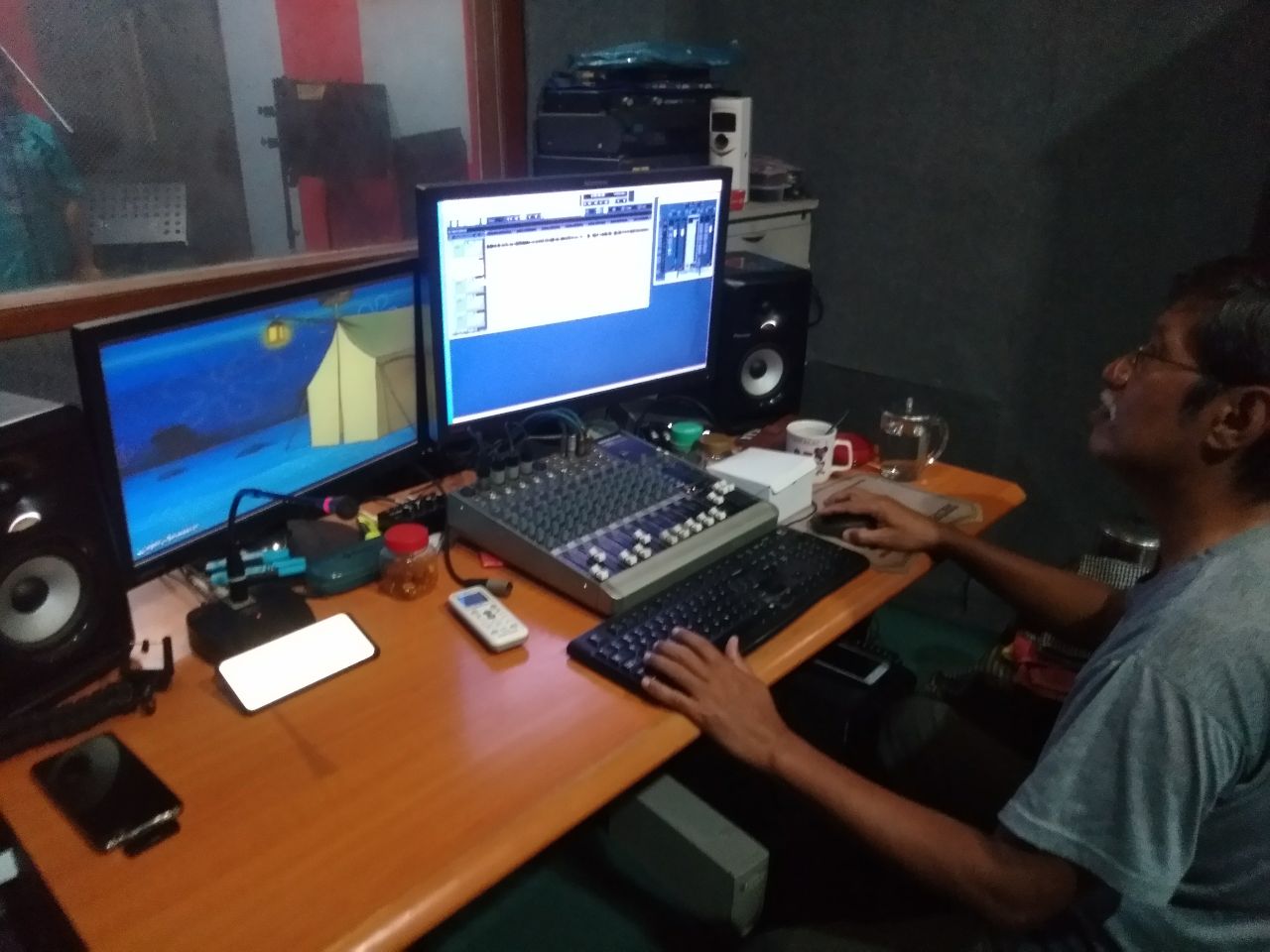
Technology has made this process so much easier compared to when I first started learning. Now, it’s easier to contact the client, recording equipment is more affordable, and dubbing knowledge is easier to access through online classes and the experiences shared by industry professionals.
In the past, I learned how to dub by observing, trying, making mistakes, and trying again.
However, the convenience of buying equipment does not automatically make a recording sound good.
For example, a voice talent who works from home still needs to understand the equipment they use. Acoustic foam is not a magical object that instantly makes a room soundproof. An expensive microphone also does not automatically solve problems with room acoustics, noise, recording distance, or microphone technique.
The more we understand what our equipment actually does, the fewer things we need to buy simply because everyone else is buying them.
In the end, I return to the same lesson I learned when I began studying voice acting: practise, explore, learn from people with experience, and then practise again.
The Indonesian Anime Times | Written by Dede Ariez Setiawan |This article was originally published in Indonesian at KAORI Nusantara on 14 September 2026 | This opinion is the personal views of the author and does not represent the views and editorial policy of The Indonesian Times or KAORI Nusantara
KAORI Nusantara invites readers to write opinions about anime, fandom, or the creative industry. You can send your opinion in Indonesian or English language to [email protected]